Published: · Last updated:
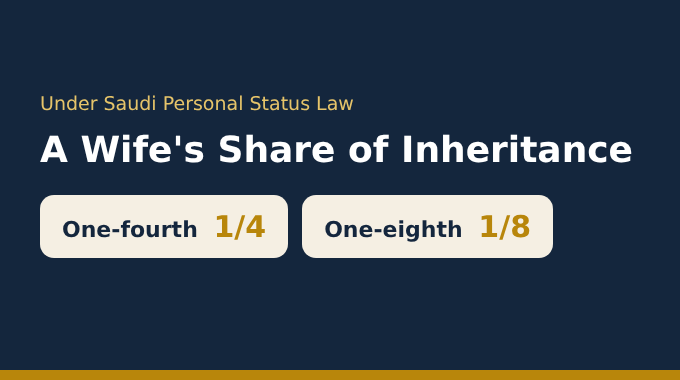
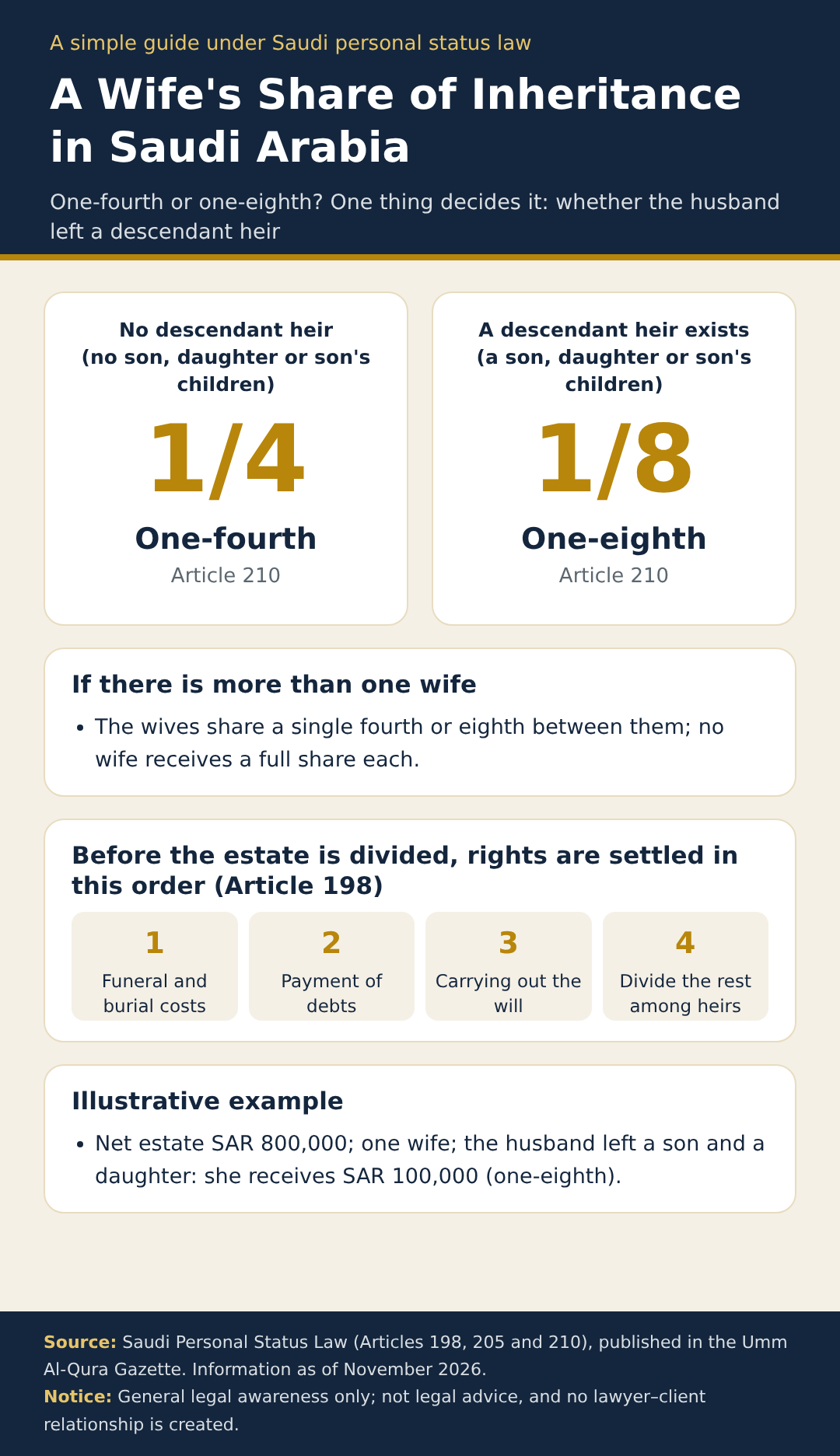
A wife’s share of inheritance in Saudi Arabia is one-fourth (1/4) of her late husband’s estate if he left no descendant heir, and one-eighth (1/8) if he did, under Article 210 of the Personal Status Law (published in English as the Family Law). When a man has more than one wife, they split a single fourth or a single eighth between them. The share is calculated on the net estate, after funeral costs, debts and the will have been dealt with. This guide walks through calculated examples, the situations in which a wife cannot inherit, and how to establish who the heirs are through the Ministry of Justice’s Legal Heirship Certificate service. If you are weighing your options in Riyadh, our directory of legal practice areas is a good place to start.
In short: a wife’s share of inheritance is the portion Article 210 of the Personal Status Law gives her from her late husband’s estate: one-fourth (1/4) if he left no descendant heir, one-eighth (1/8) if he did. Several wives share that one portion between them. The share is worked out on the net estate, after funeral costs, debts and the will are settled (Article 198).
The Personal Status Law’s own term for the relevant relatives is “descendant heir.” Under Article 205, a descendant heir is a descendant of the deceased who is entitled to inherit: a son and his children however far down, and a daughter. A person who is related to the deceased through a female, such as a daughter’s children, does not count.
Worried about losing your share of your husband’s estate, or in a dispute with the other heirs over what you are owed? Start by understanding your rights under Saudi personal status law, whether or not your late husband had children. Riyadh Lawyers Directory can help you reach a lawyer who handles inheritance cases, to review the estate and map out the right steps to claim your share.
I want an inheritance lawyer to confirm my share
Prefer to read the details first? Keep reading for a clear explanation of a wife’s inheritance share, with worked examples.
Table of Contents
When Does a Wife Inherit Under Saudi Law?
A wife is one of the legal heirs under the Islamic law applied in the Kingdom of Saudi Arabia, and she loses her right to inherit only in a few specific situations. Examples are killing the husband, or a divorce that ended the marriage before his death, unless he divorced her during his final illness without her asking and she did not remarry before he died (Article 201).
A wife’s share of the estate depends on:
- whether the husband left a descendant heir;
- whether he had more than one wife;
- who the other heirs are, which affects how the remainder is distributed or whether awl applies, but not the wife’s fixed share itself (Articles 210 and 230).
The details differ from one family to the next, so it is wise to take advice from an inheritance lawyer in Riyadh before settling on a figure, rather than relying on guesswork.
Wife’s Share When the Husband Leaves a Descendant Heir
- If the late husband leaves a descendant heir, whether from this wife or from another, the wife’s share is one-eighth (1/8) of the estate.
- How it works: first the full estate is identified, then any debts and obligations of the deceased are paid. One-eighth of the estate is set aside for the wife, and the rest is divided among the children and other heirs according to their legal shares.
Example: if the estate is SAR 100,000 and the husband left a descendant heir, the wife receives SAR 12,500 (one-eighth of the estate).
When the husband leaves a descendant heir, the wife’s share is one-eighth (1/8). Under Article 205 of the Personal Status Law, his descendant heirs are his son and his son’s children however far down, and his daughter, subject to the conditions of inheritance and the rules on exclusion. A daughter’s children are not descendant heirs because they are related to the deceased through a female. Shares can overlap in this situation, which is where an inheritance lawyer in Riyadh helps: calculating the estate correctly and preventing any encroachment on the wife’s share.
Wife’s Share When There Is No Descendant Heir
- If the husband leaves no descendant heir, the wife inherits one-fourth (1/4) of the estate. That holds even if his only descendants are a daughter’s children, since they are not descendant heirs under Article 205.
- How it works: once the value of the estate is fixed and debts and other obligations are deducted, one-fourth goes to the wife and the rest is divided among the other heirs, such as the parents, siblings or other relatives, under the Personal Status Law and the rules of Islamic law.
Example: if the estate is SAR 100,000 and the husband left no descendant heir, the wife receives SAR 25,000 (one-fourth of the estate).
Wife’s Share When There Are Multiple Wives
- If the husband had more than one wife, the wives divide the share equally. If the wife’s share is one-eighth because there is a descendant heir, for instance, that one-eighth is split among the wives.
- How it works: when there are several wives, the portion set aside for “the wife” (one-eighth or one-fourth) is divided equally among them, so each wife receives the same amount.
Example: if the deceased leaves two wives and a descendant heir, each wife receives one-sixteenth (1/16) of the estate, which is half of the one-eighth portion.
Disputes over the division are common where there are several wives. Speaking with a Riyadh inheritance lawyer helps you understand how the wife’s share is split among them under the law.
How Other Heirs Affect the Wife’s Inheritance Share
- The wife’s fixed share does not change just because the husband’s parents or siblings are alive: she takes one-fourth if he has no descendant heir and one-eighth if he does, under Article 210. Her actual amount can shrink, however, if awl applies because the fixed shares add up to more than the estate (Article 230).
- If the husband has no descendant heir, the wife’s share is one-fourth. If no other heir exists at all, whether a fixed-share heir, a residuary heir or a more distant relative, the remainder returns to her under Article 231(2). Where other entitled relatives exist, the estate is distributed under the inheritance rules that apply to them.
Estate rights are settled in this order before any division (Article 198): the deceased’s funeral and burial costs, then his debts, then the will, and finally the remainder is divided among the heirs. To see what the estate contains before debts and shares are settled, use the Ministry of Justice’s Estate Inventory service. If the estate was divided in a way that departs from the legal shares, or the heirs dispute a debt, speak to a licensed lawyer about the options.
A Wife’s Inheritance Share at a Glance
| Situation | Wife’s share |
|---|---|
| Husband leaves a descendant heir | One-eighth (1/8) |
| Husband leaves no descendant heir | One-fourth (1/4) |
| More than one wife | The share is divided equally among them |
Worked Examples: One-Fourth, One-Eighth, Several Wives, Awl and Radd
The examples below are hypothetical illustrations, not real cases. They assume there are no heirs other than those mentioned, and that the calculation is made after the funeral costs, debts and will have been dealt with.
| Scenario | Net estate (SAR) | Wife’s share (SAR) | Articles |
|---|---|---|---|
| One wife; the husband leaves a son and a daughter (descendant heirs) | 800,000 | 100,000 (one-eighth) | 210 and 205 |
| Two wives; the husband leaves a descendant heir | 800,000 | 100,000 shared: 50,000 each | 210 (paragraph 2) |
| One wife; no descendant heir | 400,000 | 100,000 (one-fourth) | 210 |
| Three wives; no descendant heir | 1,200,000 | 300,000 shared: 100,000 each | 210 (paragraph 2) |
| Awl: wife + two daughters + father + mother | 2,700,000 | 300,000 instead of 337,500 (3/27 instead of 3/24) | 210, 215, 211, 213 and 230 |
| Radd: wife + one daughter and no other heir | 800,000 | 100,000 (one-eighth); the rest returns to the daughter | 210, 215 and 231 |
Awl Example (Article 230)
Where the fixed shares add up to more than the estate, they are cut back (this is awl), with every heir’s share reduced in proportion. In the example, the shares are worked on a base of 24: the wife takes 3 (one-eighth), the two daughters take 16 (two-thirds), the father takes 4 (one-sixth as a fixed share, Article 211, paragraph 2) and the mother takes 4 (one-sixth because there is a descendant heir, Article 213). That totals 27 out of 24, so each share is scaled down in proportion and the wife receives 3/27, which is SAR 300,000 of the SAR 2,700,000 estate. The two daughters receive SAR 1,600,000 between them (SAR 800,000 each), the father SAR 400,000 and the mother SAR 400,000.
Radd Example (Article 231)
If the fixed shares do not use up the whole estate and there is no residuary heir, the remainder goes back (radd) to the fixed-share heirs other than the spouses, in proportion to their shares. So the wife takes only her fixed share (one-eighth), and the remainder (SAR 700,000 of SAR 800,000) returns to the daughter. The remainder does not go back to a spouse unless there is no other heir at all, whether a fixed-share heir, a residuary heir or a more distant relative.
When a Wife Does Not Inherit From Her Husband
To inherit, the deceased must have died, the heir must have outlived him, there must be a ground for inheriting, and no bar to inheritance may apply (Article 199). The bars that can affect a wife’s share of inheritance include:
- Killing: a person who intentionally and unlawfully kills, or semi-intentionally kills, the person they would inherit from does not inherit, nor does someone who unlawfully caused or ordered the killing. A person who kills by mistake still inherits from the estate but not the blood money (Article 200).
- Separation during the husband’s lifetime: a divorce, for example, ends mutual inheritance. The exceptions are a revocable divorce, where the spouses still inherit from each other while the wife is in her waiting period (iddah), and a divorce the husband pronounces during his final illness without her request, in which case she inherits from him unless she remarries before his death (Article 201).
- Difference of religion: there is no inheritance between people of different religions, subject to the will provisions in the law (Article 202).
- Deaths at the same time, or where it is not known who died first: the deceased do not inherit from one another (Article 203).
Common Mistakes That Cost a Wife Her Inheritance Share
Watch for these mistakes when claiming a wife’s share of inheritance:
- Relying on an informal family division with nothing documented.
- Waiting too long to claim.
- Signing a waiver without understanding it legally.
- Confusing a gift with an inheritance.
- Not going to court when there is a dispute.
These mistakes can cost a wife a large part of her inheritance or drag her into long disputes.
Avoiding them takes early legal awareness, which is why speaking with an inheritance and estates lawyer in Riyadh can protect you from unknowingly losing part of what you are owed.
How to Prove the Heirs and Inventory the Estate Through the Inheritance Platform
The steps below are taken from the Ministry of Justice’s official service pages, last checked on November 8, 2026.
1. Issuing a Legal Heirship Certificate
This online service issues a certificate that lists the deceased, the heirs and their shares. Source: the Ministry of Justice’s Legal Heirship Certificate page.
- Log in to the Inheritance Platform (Merath) with your National Single Sign-On credentials.
- Open “Electronic Services.”
- Choose “Legal Heirship Certificate.”
- Click “Start Service.”
- Agree to the terms and declarations, then enter the applicant’s details, the deceased’s details, the heirs’ identification, the heirs and the witnesses.
- Review the application.
- Click “Save and Submit.”
The published requirements are: the supporting documents the form asks for (such as the death certificate), full details of all the heirs and witnesses, a valid power of attorney if the applicant acts for an heir (a foreign power of attorney must be authenticated by the Ministry of Justice), and Ministry of Justice authentication of any document issued outside the Kingdom.
2. Issuing an Estate Inventory
This service issues a certificate covering the deceased’s money, assets and documented rights connected to the estate. Source: the Ministry of Justice’s Estate Inventory page.
- Log in to the Inheritance Platform with National Single Sign-On.
- Click “Electronic Services,” then the “Estate Inventory” service.
- Select the deceased’s name from the list.
- Click “Start Estate Inventory.”
- The applicant is notified as soon as the relevant authorities supply the inventory information.
3. Agreed Distribution of the Estate
This service distributes the deceased’s money and assets among the heirs according to their legal shares and the applicable rules. The platform lists completed estate inventory requests that have not yet been distributed. The heir selects the request and the type of asset (cash, investments or real estate), reviews the proposed distribution, confirms and authenticates through National Single Sign-On, and follows the other heirs’ responses. Source: the Ministry of Justice’s Agreed Distribution of Estate page.
Fees and Processing Times
At the last check (November 8, 2026), the three service pages did not publish a fee or a specific processing time, so check the official service page before you apply.
When Does a Wife Need a Lawyer Who Handles Inheritance Cases?
Consider hiring an inheritance lawyer in Riyadh if:
- the heirs are in dispute;
- the distribution of the estate is delayed;
- the estate includes real estate or substantial assets;
- the husband had more than one wife;
- the wife has been denied her share.
A lawyer can help by:
- filing an estate distribution lawsuit;
- calculating each heir’s share precisely;
- resolving the dispute lawfully;
- protecting your rights without escalating a family conflict.
Finding an Inheritance Lawyer in Riyadh
Many heirs look for a lawyer in Riyadh who handles inheritance cases under the Personal Status Law and the related regulations.
Specialist legal advice helps you:
- know your correct legal share;
- speed up the court process;
- protect your rights without getting drawn into long disputes.
Steps to File an Estate Distribution Lawsuit in Saudi Arabia
- Obtain the death certificate.
- Obtain the legal heirship certificate.
- Identify the estate (real estate, money, accounts).
- File the lawsuit with the competent court.
- The court hears the case and attempts reconciliation.
- A judgment is issued and the distribution is carried out.
Frequently Asked Questions About a Wife’s Share of Inheritance
What is a wife’s share of inheritance in Saudi Arabia?
A wife takes one-fourth (1/4) if her deceased husband left no descendant heir, and one-eighth (1/8) if he did, whether the descendant is hers or from another marriage, under Article 210 of the Personal Status Law. The share is calculated on the net estate. Under Article 205, a descendant heir is a son or daughter and the son’s children however far down, subject to the conditions of inheritance and exclusion. Children who trace their line through a female, such as a daughter’s children, do not count.
Does each wife get a full one-fourth or one-eighth when there are several wives?
No. Several wives share the single portion fixed for a wife under Article 210. If the portion is one-fourth, that fourth is divided equally among them. If it is one-eighth, the eighth is divided among them. For example, on an estate of SAR 800,000 where the husband left a descendant heir, the eighth is SAR 100,000, and each of two wives receives SAR 50,000.
When does a wife not inherit from her husband?
Inheritance can be barred if the wife intentionally and unlawfully killed her husband, or caused his death by quasi-intentional killing (Article 200), by a difference of religion, subject to the rules on wills (Article 202), or by separation between the spouses during his lifetime. The exception is a revocable divorce during the waiting period, or a divorce during his death illness that she did not request, provided she had not remarried before his death (Article 201).
What is awl and how does it affect a wife’s share?
When the fixed shares of the heirs add up to more than the estate, they are reduced proportionally. This is called awl, and it is set out in Article 230. A wife then receives less than the one-eighth or one-fourth calculated on paper, but she bears the same proportional reduction as the other fixed-share heirs and is not exempted from it.
How do I prove I am an heir and obtain a legal heirship certificate?
The certificate is issued through the Ministry of Justice Inheritance Platform. You sign in with Nafath, open the e-services, choose the legal heirship service, start the request, enter the details of the applicant, the deceased, the heirs and the witnesses, then review, save and submit it. Supporting documents such as the death certificate may be requested.
Summary: What Is a Wife’s Share of Inheritance and What Should You Do Next?
A wife’s share of inheritance is one-fourth (1/4) if the husband leaves no descendant heir and one-eighth (1/8) if he does. Several wives share that single fixed portion, and it is calculated on the net estate after funeral costs, debts and the will (Articles 198, 205 and 210). Her actual amount can be reduced by awl (Article 230). The remainder returns to her only if she is the sole heir and there is no other fixed-share heir, residuary heir or more distant relative (Article 231(2)). She does not inherit at all if a bar to inheritance applies, such as killing or a difference of religion (Articles 200 and 202). That is why working out the fraction alone is not enough: every entitled person and every right attached to the estate has to be checked. It is wise not to delay claiming or documenting the share. How much time passing matters depends on the facts of each case and on the competent court. To protect the share, it also helps to understand how a claim for inheritance is brought: see our guide to legal practice areas in Riyadh.
Next step: start by obtaining a legal heirship certificate through the Inheritance Platform, then take the documents to the competent court or to a licensed personal status lawyer through our contact page if the division is disputed.
Disclaimer: this content is for general legal awareness. It is not legal advice, and it does not create a lawyer–client relationship. Riyadh Lawyers Directory is a neutral directory, not a law firm. Rulings vary with the facts and documents of each case, and special cases should be referred to the competent court or a licensed lawyer. The information is accurate as of November 2026. The statutory references follow the official English translation of the Family Law (Royal Decree No. M/73) published by the Bureau of Experts at the Council of Ministers, which is provided for guidance; the Arabic text governs.